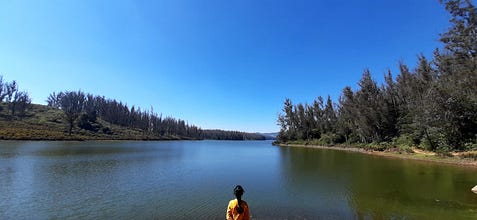


A decade ago, I was in Burja, a quaint village nestled just beyond Alwar, Rajasthan. I remember waking from a deep, restful sleep, slowly sipping a cup of hot coffee, and stepping out for an aimless morning walk. It was one of those rare, unhurried mornings when time seemed to have paused, leaving me with nothing to do but wander and absorb the serenity around.
It was a beautiful scene, and one that feels increasingly rare these days: people gathered around crackling woodfires, boiling water and preparing food, while cows mooed and goats bleated somewhere nearby. The morning was chilly and quiet. A few birds chirped in the distance, while children watched me with innocent curiosity, wondering who this stranger wandering through their village was. A few warmly greeted me and asked where I had come from.
As I walked on, I noticed a tiny, unassuming temple built almost seamlessly into the side of a house. From the street, it looked small and ordinary. But stepping in from the morning chill and crossing its threshold revealed a surprisingly intricate, almost maze-like interior.
There was no one around, yet the fragrance of fresh incense filled the space. A faint flute melody seemed to float through it, almost indistinguishable from the silence.
It only took a few notes of that melody to steer me towards those familiar mornings when time moved at three different speeds: Rushed for our parents, a quiet ritual for our grandparents, and a sweet, hazy space in between for us.
Dad getting ready for work. Mom in the kitchen. Us, still groggy-eyed, getting ready for primary school. Grandmother humming some chants in front of Tulsi Katte. Grandfather sitting in front of the old Dianora TV, switching between a few channels we had — DD National, Gyan Darshan and DD Chandana — with that tiny piece of plastic as the TV tuner.
No remote. No endless channels. Nothing to scroll through.
And somewhere between the morning news breaks, that beautiful jingle would play.
For anyone who grew up in the 1990s, the National Literacy Mission jingle is more than a memory; it is woven into our sonic DNA. Kavita Krishnamurthy’s breathtaking rendition of Purab Se Surya Uga may have been created for a literacy campaign, but it never felt like just another jingle. There was something about both its composition and her rendering that affected deeply. Even decades later, it is hard to hear those opening notes without a lump in the throat and eyes suddenly welling up with nostalgia. The stream of tearful comments beneath the song on YouTube reveals something strangely collective — a shared longing for a time that has quietly slipped away.
The entire jingle lasts barely a minute. Yet its imprint remains remarkably intact: tender, bittersweet and beautiful, even three decades after the 1990s disappeared behind us.
I was probably still in primary school then. I had no idea what a raga was, nor did I particularly care. I only knew that the music felt soothing and peaceful, as though it belonged to those quiet mornings. A few phrases from the melody somehow found their way into my memory and remained there, even as the years rolled by.
Years later, YouTube gave me a way back to those sounds. I could finally find the jingle again, hear it in its entirety, and rediscover the music that had been tucked away somewhere in my childhood. It was only then, after I had begun learning about ragas, that I recognised what I had been hearing all those years ago.
I had felt Bhatiyar long before I knew its name.
Bhatiyar feels like the musical equivalent of a sunflower. Just as a sunflower slowly turns its face towards the morning sun, Bhatiyar seems to unfurl with the first light of day. There is something tentative yet luminous about it, as though the raga itself is waking up.
Bhatiyar’s scale has a zigzag (vakra) arrangement of notes, with different schools of thought following different versions. In certain interpretations, introducing a delicate touch of Teevra Ma (the augmented 4th) enhances the scale’s beauty even further — provided the performer can present that subtle glimpse without drifting away from the core soul of the raga.
And there is an intriguing connection here. In the Carnatic melakarta system, the 17th scale is Suryakantam — a name that immediately brings the sun and sunflower to mind. In Muthuswamy Dikshitar’s school of thought, the same scale is known as Chayavati — which omits the panchamam while ascending.
I find something strangely beautiful in those two names existing side by side: Suryakantam, the sun and its brightness; Chayavati, its lingering shadow. Somewhere between the two lies the dawn— the sun not yet fully risen, the shadows still lingering, the world slowly coming awake.
Perhaps that is also why Bhatiyar has always spoken to me differently from most renditions of its Carnatic cousin, Suryakantam. Some may feel subtle strains of Manoranjani too. Well, Bhatiyar seems to breathe when treated slowly, allowing its phrases to unfold without hurry. Many Suryakantam renditions I came across felt more academic to me, slightly hurried, driven by the pressure to navigate fast-paced brikhas, demonstrate technical command, or showcase the intricacies of the raga. There was certainly virtuosity, but I often missed the languor — the feeling of a morning with nowhere to go and nothing demanding your attention.
It may be unfair to compare the two purely through performance, but for me, the difference was palpable. Bhatiyar seemed to inhabit time differently. It did not announce the morning; it seemed to let the morning happen.
Despite its foundational place as the 17th melakarta, Suryakantam remains a rare visitor to the Carnatic concert stage. Its presence is most vividly felt through Saint Tyagaraja’s treasured kriti, Muddumomu, with only a few artists occasionally choosing to expand it into the elaborate canvas of a Ragam Tanam Pallavi.
Because Bhatiyar subtly weaves in that touch of Teevra Ma (or Prati Madhyamam), a sensitive ear might also catch fleeting, evocative echoes of ragas like Gamanashrama or its derivative Poorvikalyani, though that is perhaps more a personal, intuitive perspective than a formal classification.
Meanwhile, Bhatiyar, in Hindustani tradition, lives on as a deeply cherished and timeless early-morning raga, forever woven into the quiet magic of dawn.
While several film tracks have explored this raga, none have resonated with me quite like Naina Neer Bahaye. To my ears, it stands as one of A. R. Rahman’s most underrated masterpieces — a song the maestro himself revealed was inspired by Purab Se Surya Uga, composed by Ashok Patki. Interestingly, it remains his sole composition in Raag Bhatiyar to date. What makes it so fascinating is the contrast — the jingle evokes the gentle bliss of a slow morning to promote literacy, whereas Naina Neer Bahaye becomes a poignant, desperate plea to the divine.
The suspended space
Perhaps that is what music does best: it preserves the things that time cannot.
The village of Burja has likely changed. Those woodfires may have gone cold, and the children who watched a stranger walk past are now adults. Grandfather’s Dianora TV is long gone, decades ago, and DD National no longer defines our world.
Living slightly away from the city, my life moves in different, unpredictable morning rhythms. Some dawns are rushed, while most unfold with sweet luxury. Some follow a night of deep, restorative sleep, while some begin weary and bleary-eyed. Most mornings are filled with quiet, comforting cuddles with my boy, a few spent boarding early trains, and the pleasant, familiar sounds outside my window — the deep call of a coucal, the sharp twitters of sunbirds, and the lively chatter of bulbuls.
On those occasional train commutes, sitting by the window and watching the physical world whizz past at speed while listening to Bhatiyar, a thought often comes to mind, and I find myself pondering the nature of balance. Where does that elusive, suspended space truly lie?
Perhaps true stillness isn’t about total isolation or permanently escaping to a remote village. Long before that walk in Burja, I had already left the city behind for the slower rhythm of a sprawling town. But peace, I’ve realized, is an inner geography. It is about learning to inhabit that suspended space in our own minds — the middle ground between the still and the rushed, where lingering shadows meet the morning light.
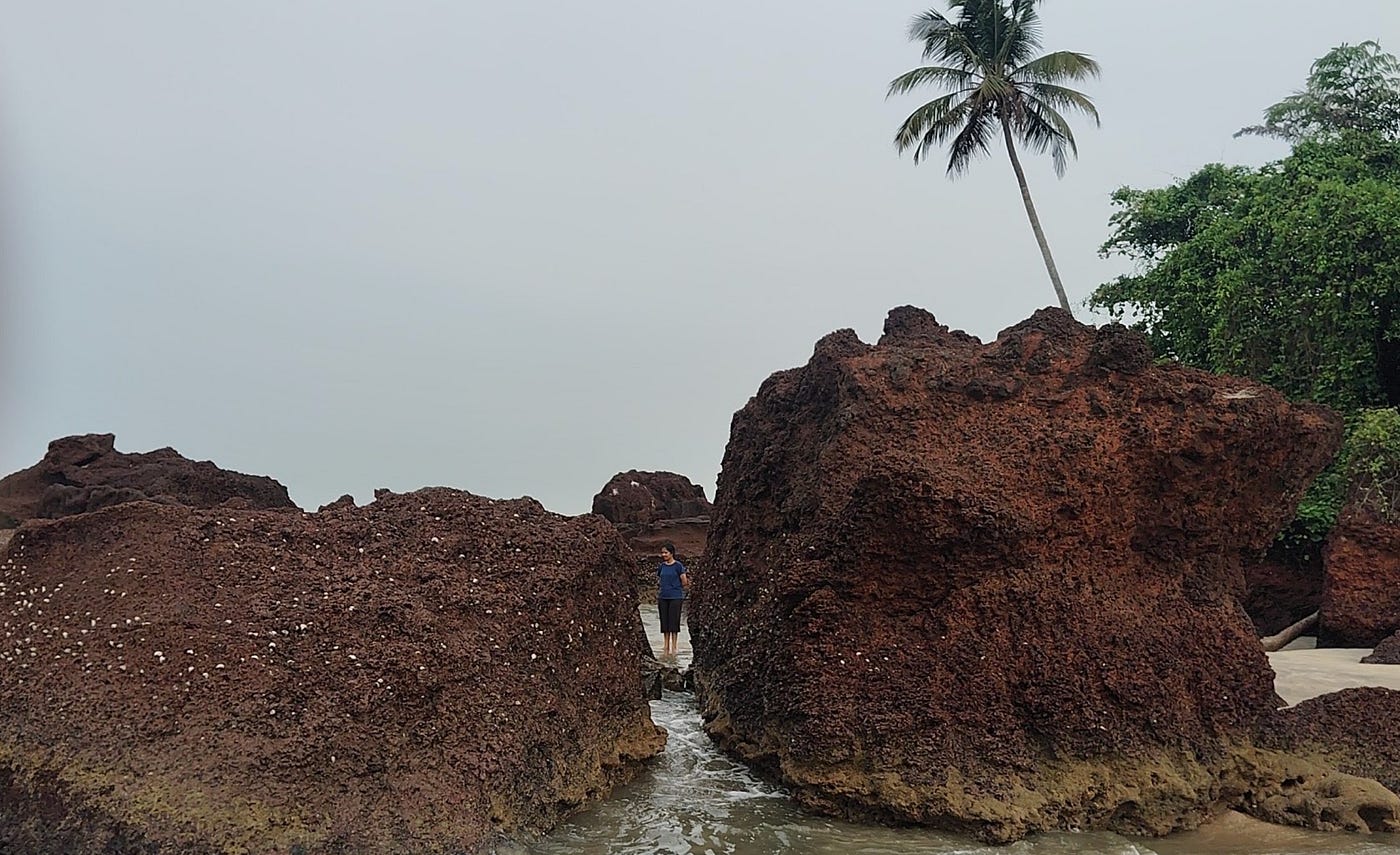
Maybe I’m still learning to navigate that balance. Or perhaps, between these hurried and unhurried dawns, I am no longer chasing it, but already living it.
That suspended space is precisely where I feel Bhatiyar lives. And much like the intricate, maze-like phrasing of Raga Bindumalini, it is a labyrinth you willingly let yourself get lost in, without ever needing to find the exit!